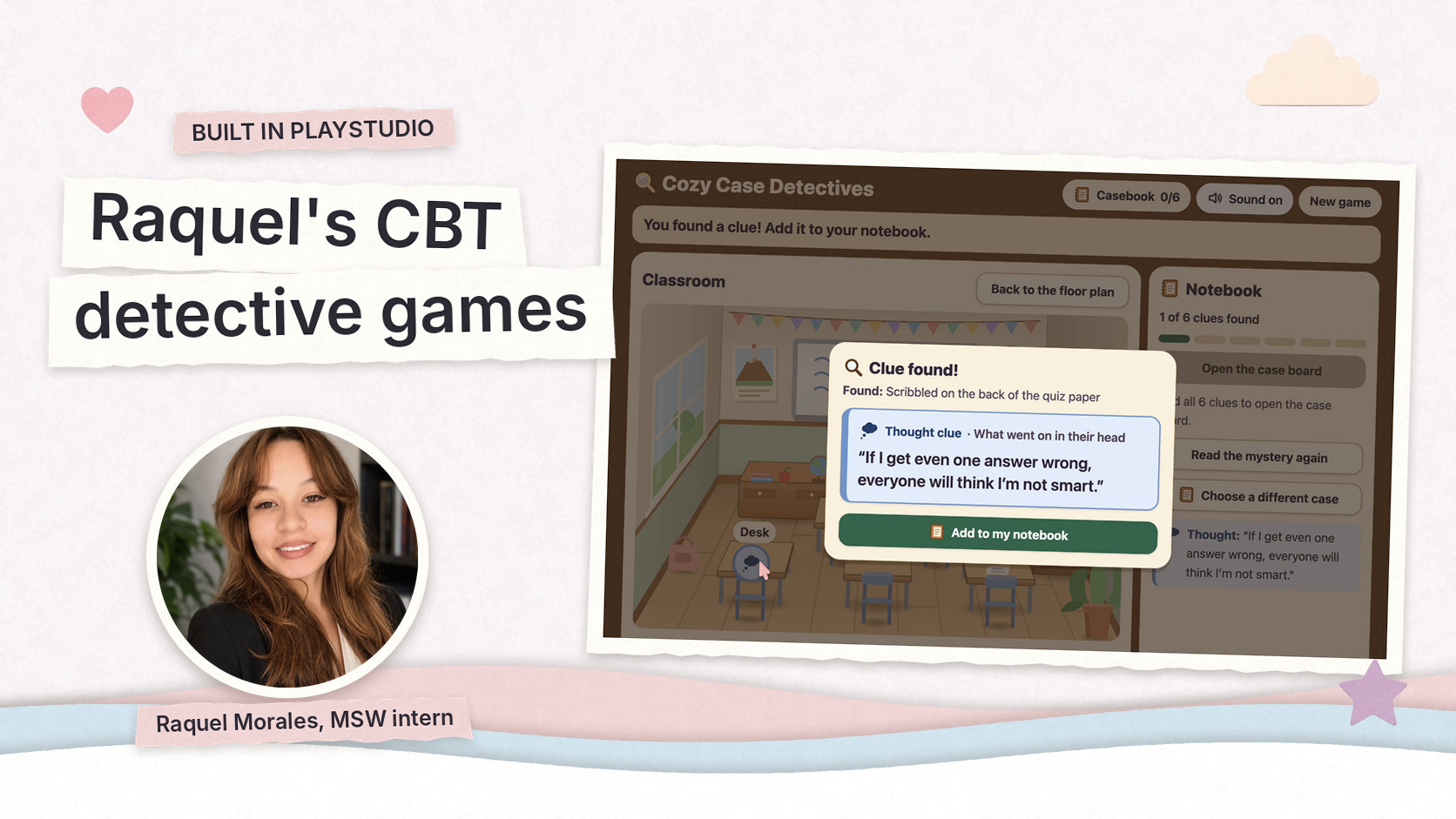

Raquel Morales builds her own therapy games in PlayStudio: a CBT detective game, a courtroom for unhelpful thoughts, emotional check-ins and a body sensations map. She’s a Master of Social Work (MSW) student intern at Bay Area Behavioral Services (BABS), where she sees clients aged 7 to 76 through telehealth and in person.
We asked Raquel what she’s built, how one game played out in a session, and what she’d tell a clinician trying PlayStudio for the first time. Her answers are below, lightly edited.
What’s your role, and who do you work with?
I am a Master of Social Work (MSW) student intern at Bay Area Behavioral Services (BABS), providing individual therapy through telehealth and in-person sessions. I work with children, adolescents, adults, and older adults, ranging in age from 7 to 76. My clinical focus includes emotional regulation, anxiety, trauma, coping skills, communication, and strengthening relationships. I enjoy using creative, evidence-informed approaches that meet clients where they are and make therapy meaningful and engaging.
How did you start using PlayStudio?
I was introduced to PlayStudio by my mentor, Angel Heiney, a clinician at Bay Area Behavioral Services. Through her recommendation, I began exploring ways to make telehealth sessions more interactive while supporting therapeutic goals. I quickly saw an opportunity to combine creativity, technology, and evidence-informed interventions to develop activities tailored to clients’ interests and needs.
What games or assessments have you built so far?
I’ve developed several interactive activities that bring therapeutic concepts to life, including:
- Cozy Case Detectives: a CBT-inspired detective game where clients explore clues, identify emotions and thought patterns, and choose coping skills to solve challenges.
- Thought Trial: a CBT courtroom activity where clients examine evidence for and against unhelpful thoughts and develop more balanced perspectives.
- Rose, Bud and Thorn: an emotional check-in exploring something positive, something they’re looking forward to, and something challenging.
- Say It Your Way: Healthy Communication Builder: an interactive tool where clients practice turning difficult statements into healthier communication using I-statements, DEAR MAN, and assertive communication skills.
- Circle of Control: a sorting activity helping clients identify what is within or outside their control and explore helpful responses.
- My Sensations Map: a visual activity connecting emotions with physical sensations to strengthen emotional awareness.
I’ve also created creative letting-go activities that encourage clients to process difficult thoughts and feelings through art, reflection, and self-expression.
Walk us through one build
One activity involved developing a collaborative coping-skills game where the therapist and client explored everyday challenges, emotions, and problem-solving strategies. The goal was to encourage reflection and practice coping skills through an engaging experience. During the session, the game naturally encouraged conversation, while inviting feedback allowed the client to help shape and improve the activity. This created opportunities for self-expression, collaboration, and meaningful therapeutic discussion.
What surprised you?
What surprised me most was how naturally clients engaged and how eager they were to contribute ideas. Allowing clients to help shape the experience encouraged ownership and participation. I also noticed that playful interactions opened the door to conversations that might otherwise feel difficult through traditional questioning.
What would you tell another clinician thinking about trying it?
Start small, stay curious, and focus on the therapeutic goal rather than creating the perfect game. Consider your client’s interests, developmental needs, and the skills you want them to practice. Be open to feedback and let the activity evolve. For me, PlayStudio demonstrates how technology and creativity can strengthen therapeutic engagement without replacing the importance of the therapeutic relationship.
How PlayStudio works
You describe an activity in a sentence, and PlayStudio builds it. You try it, improve the prompt if needed, then name it and publish it to the playrooms you pick. Simple activities build in a few minutes; complex 3D ones take longer.
Each activity is built for a client and a therapist, with turns, prompts and a place to save the work. You can play side by side on one device, together inside a video session, or the client can play on their own. PlayStudio is part of Studio, in every PlaySpace plan.
Want to see it in a real session? Book a free, personalized demo.
Frequently asked questions
What is PlayStudio?
PlayStudio is the PlaySpace feature that builds custom games, activities and assessments from a short description. Clinicians use it to make activities for one client or for every playroom.
How long does a build take?
Simple activities take a few minutes. Complex 3D ones take longer, and you can leave and come back.
Can I use PlayStudio activities over telehealth and in person?
Yes. In person, you sit side by side and take turns on one device. Over video, you and your client play the same activity at the same time and both see every move.
Who sees an activity before it’s published?
Only you. It stays a draft in your library until you publish it.
Built something in PlayStudio?
This is the first post in Built in PlayStudio, where clinicians show what they’ve made. If you’ve built something you’re proud of, email Elizabeth at drcawley@playspace.health.
About Raquel Morales
Raquel Morales is a Master of Social Work student intern at Bay Area Behavioral Services (BABS), providing individual therapy through telehealth and in-person sessions. Her focus includes emotional regulation, anxiety, trauma, coping skills and communication.
Sources
- Raquel Morales, written interview with PlaySpace, November 18, 2026.
- PlayStudio feature page, PlaySpace.