
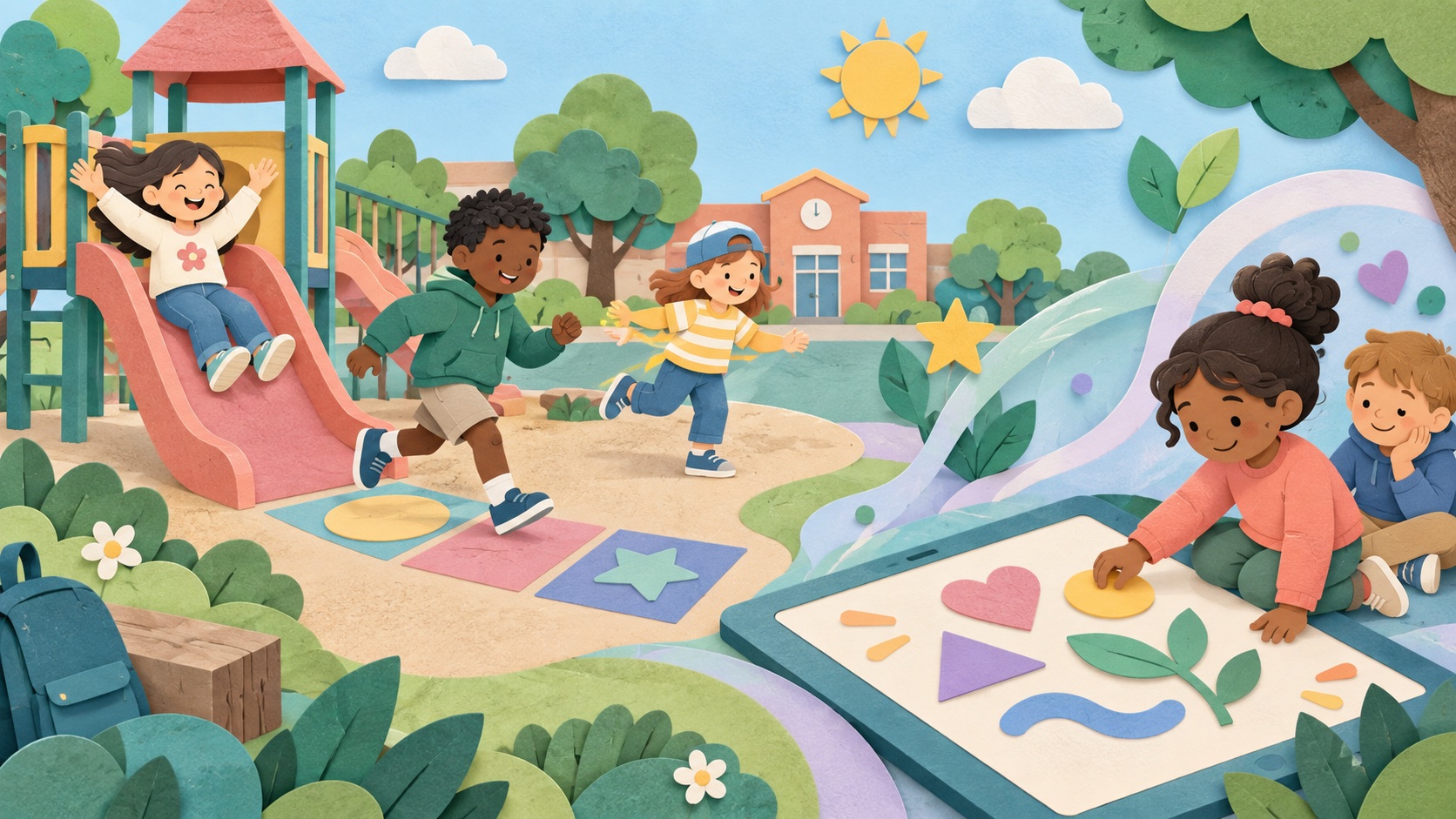
What Recess and Therapy Have in Common: It’s More Than You Might Think
Ask a group of seven-year-olds what their favourite part of the school day is.
You already know the answer.
It’s not literacy centres. It’s not math. It’s the moment the bell rings, the doors swing open, and they pour onto the playground with all the barely-contained energy of a shaken soda can.
Recess.
Now ask a child what they think about therapy.
Most haven’t been. The ones who have will give you answers that range from “it’s okay” to “we play games” to a shrug that communicates complex ambivalence in a single gesture.
Here’s what I’ve been thinking about lately: the best child therapy sessions I’ve run have had more in common with a good recess period than with anything that looks like a traditional clinical hour. And the more I’ve explored what makes recess developmentally powerful, and what makes creative digital therapy environments effective, the more I’ve noticed they’re pulling from the same well.
This isn’t a coincidence. It’s a clinical insight worth unpacking.
Recess Isn’t a Break From Learning. It’s Where Learning Lives.
We’ve been getting recess wrong for decades.
For much of the twentieth century, recess was treated as a reward or a release valve. Children were allowed to go outside and run because sitting still all day was producing restless, dysregulated kids who couldn’t focus. The logic was essentially hydraulic: let off some steam, come back inside, learn. But the research has dismantled that model completely.
Recess is not a break from development. Recess is where a specific, irreplaceable kind of development happens. Free play is biologically necessary to healthy brain development. The American Academy of Pediatrics has called recess an essential component of the school day, citing evidence that unstructured outdoor play improves attention, memory, cognitive flexibility, emotional regulation, and social competence.
Children aren’t running around at recess burning off energy. They’re practicing negotiation. Building and breaking alliances. Managing frustration when they’re left out. Creating and revising rules in real time. Learning to read faces, bodies, and tone. Discovering what kind of friend they want to be.
None of that looks like learning. All of it is.
The same reframing applies to creative digital therapy environments. A child who spends a session building a sandtray scene, or playing a collaborative game, isn’t taking a break from therapeutic work. They are doing the therapeutic work in the medium that is most natural, most neurologically accessible, and most clinically effective for their age.
The Five Things Recess and Creative Digital Therapy Share
When I started mapping what research tells us about effective recess against what we know about effective creative therapy with children, five core parallels kept emerging.
1. Choice Is the Active Ingredient
The moment the bell rings, children make choices. Where to go. What to play. Who to play with. Whether to join or observe. Those choices are not incidental to the developmental value of recess; they are the developmental value.
Self-determination theory identifies autonomy as one of three core psychological needs. When children experience genuine choice, intrinsic motivation increases. Engagement deepens. Learning sticks.
In a creative digital therapy environment, the same principle holds. When a child opens PlaySpace and chooses to go to the sandtray rather than the dollhouse, selects a wizard figure rather than a person, picks a colour for the whiteboard drawing that only they understand, those choices are clinically significant. They are expressions of the child’s internal world, offered freely in a space that feels safe enough to make them.
The therapist’s role, in both recess and play therapy, is less about directing and more about creating the conditions for authentic choice to occur.
2. Low Stakes Create High Access
Watch children at recess. The ones who are typically most hesitant, such as anxious kids, children with social difficulties, or those who have recently experienced disruption, will often hover at the edges at first. But because there’s no grade. No right answer. No adult is evaluating their performance. They eventually move in.
This is one of the most underappreciated features of unstructured play: the low-stakes environment lowers the threat response enough for genuine participation to become possible.
Creative digital therapy works identically. When a child who is terrified of doing things “wrong” sits down with the digital sandtray and hears “there’s no right way to do this, just show me your world,” something visibly shifts. The shoulders drop. The fingers start to move. The play begins.
3. The Body and the Brain Both Come
Recess is one of the few spaces in a child’s structured day where their body is fully involved. Running, spinning, climbing, building, tumbling. The sensorimotor engagement isn’t separate from the cognitive and emotional benefits; it’s inseparable from them. The nervous system regulates through movement. The brain consolidates learning through physical experience.
In therapy with children, body-brain integration matters enormously. Children don’t separate their physical experience from their emotional one. Sitting still in a chair and talking is neurobiologically misaligned with how children process and integrate experience.
Creative digital therapy environments invite embodied engagement. Dragging figures across a sandtray. Drawing on a whiteboard. Tapping, clicking, building, arranging. The hands are moving. The child is present in a way that is simply not possible in a purely verbal clinical interaction.
4. Peer Dynamics Are the Curriculum
Some of the richest social-emotional learning at recess doesn’t happen in the activity itself. It happens in the negotiation before, the conflict during, and the repair after.
“You’re not playing fair.” “I don’t want to be that character.” “That’s not how the rules work.” “Fine, I’m telling.”
Every one of those moments is a live social-emotional skills lab. Children are developing theory of mind, perspective-taking, conflict resolution, and emotional regulation in real time, in conditions that actually matter to them.
Multiplayer games within a creative digital therapy environment mirror this dynamic with extraordinary fidelity and add therapeutic intentionality. When a child and therapist play a collaborative game inside PlaySpace, the therapist can observe, name, and gently intervene in exactly the same dynamics that appear on the playground.
5. A Safe Adult Nearby Changes Everything
Here’s something worth noticing: the same child who is frozen in the hallway, refusing to go to class, the same one who can’t make eye contact in the initial intake, will often run onto the recess yard, glance back once to make sure a familiar adult is still there, and then disappear into play.
The adult doesn’t need to do anything. They just need to be there.
John Bowlby called this the “secure base,” the reliable presence that makes exploration possible. Children don’t need us to scaffold every moment of their play. They need to know we’re there if they need us, that we won’t disappear, and that what they’re doing matters to us.
In creative digital therapy, the therapist’s presence functions the same way. A child exploring the PlaySpace environment, choosing figures, building scenes, and clicking through stories, is not ignoring the therapist. They are exploring from a secure base. The therapist’s calm attention, gentle reflections, and unhurried presence make the exploration feel safe.
What Happens When Children Don’t Get Either
Recess is under threat. In schools across North America, recess periods have been shortened, eliminated as punishment, or replaced with structured programming in response to academic pressure and risk-averse administration. The research on what this does to children is unambiguous and grim: reduced recess correlates with increases in childhood anxiety, attention difficulties, dysregulation, and social conflict.
Children who don’t get unstructured play time don’t just miss out on fun. They miss out on the developmental experiences that regulate their nervous systems, build their social competence, and give them agency in a world that often feels entirely outside their control.
For these children, creative therapy environments don’t just supplement clinical work. They restore something that was missing. They hand the child back the pen.
Build a Therapy Space Children Actually Want to Come Back To
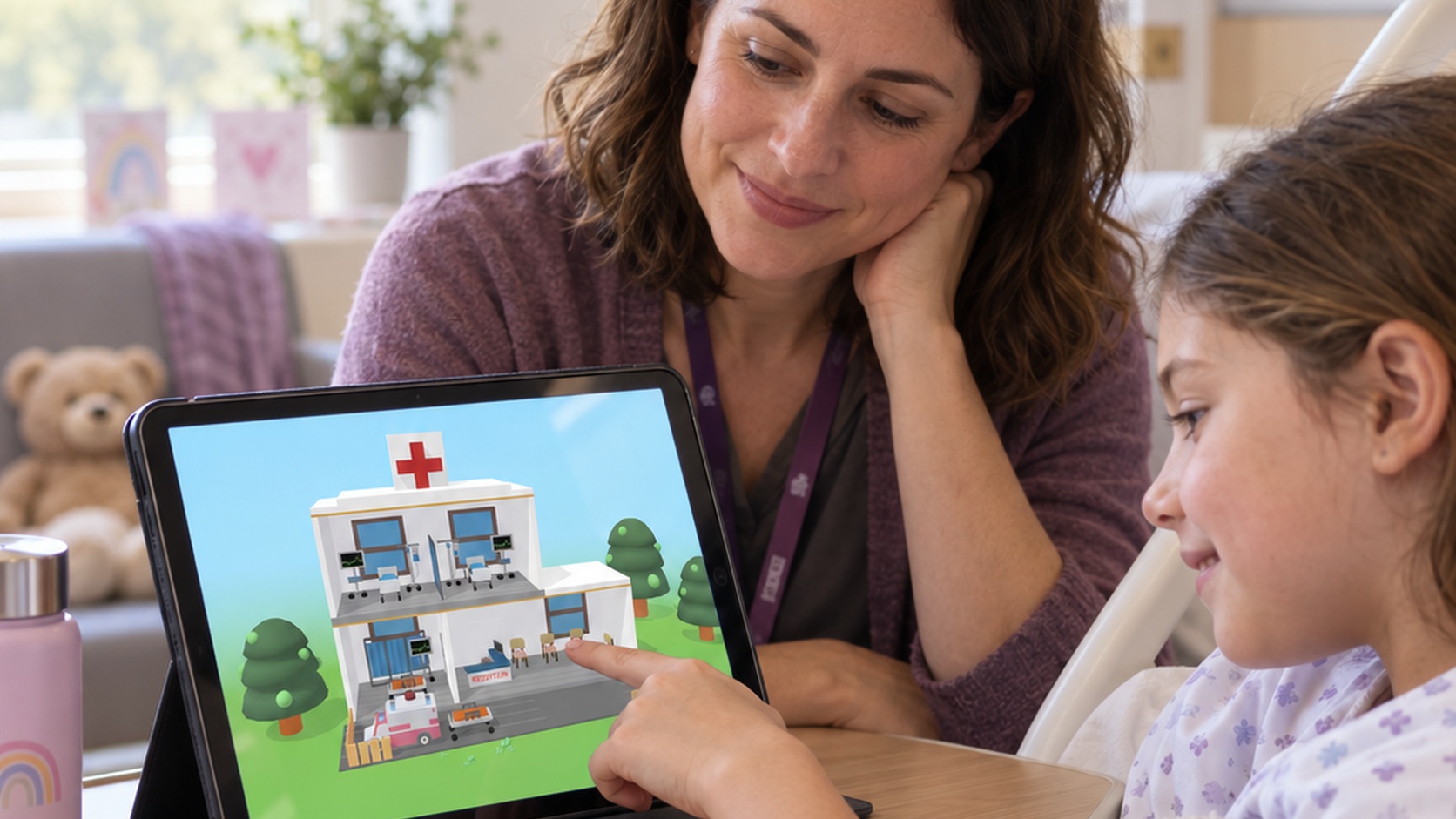
PlaySpace is designed to bring the developmental power of creative, unstructured, child-led play into every therapy session, virtual or in person.
Try PlaySpace free at https://www.playspace.health/and design the kind of digital therapy environment where your youngest clients feel safe enough to show up fully.

.jpg)