

She didn’t want to talk about her dad.
Nine years old, referred to me three months after her father’s sudden death. Her mother said she was “fine” at school, “fine” at home, but would then erupt without warning into inconsolable crying or explosive anger that seemed to come from nowhere.
In our first few sessions, she sat with her arms crossed. Classic avoidance. Classic grief.
Then one afternoon, I opened the sandtray and said nothing. Just gestured to the figures. She chose a wolf, a hollow tree, a small stone bridge, and a single bird. She placed them carefully. Then she looked up at me and said, “The bird doesn’t know where to go.”
We worked with that bird for months.
She never once said the word “grief.” She didn’t need to. The symbol held everything words couldn’t carry, and the therapeutic work that happened around that bird was clinically meaningful.
Symbolic expression in grief therapy isn’t a workaround for clients who won’t talk. It’s often the most direct route to the heart of what loss really does to a person.
Why Grief Resists Language — Especially in Young and Neurodivergent Clients?
Grief is a full-body, full-brain experience. And for children, adolescents, and neurodivergent individuals, the cognitive and linguistic tools required to process loss verbally are often simply not available. This is not because the person is unwilling, but because the experience of grief lives somewhere language hasn’t reached yet.
Neurobiologically, acute grief activates the limbic system and particularly the amygdala and hippocampus, while simultaneously suppressing prefrontal cortex function. In plain terms, grief literally reduces a person’s capacity for verbal reasoning, narrative construction, and emotional articulation. This is true for adults, but it is compounded significantly for developing brains.
For children under twelve, abstract emotional concepts like “grief,” “loss,” and “finality” are genuinely difficult to process in the abstract. Children think concretely and symbolically. A bird that doesn’t know where to go is far more emotionally accessible than a conversation about mortality.
For teenagers, the picture is different but equally complex. Adolescents are often exquisitely aware of their grief and deeply resistant to exposing it. Vulnerability is a threat. Talking directly about loss can feel unbearable. Symbolism creates “protective distance” that allows teens to engage with unbearable material from a safer vantage point.
Symbolic expression doesn’t ask clients to translate their internal experience into a language that may not fit. It invites them to show what they know in ways that feel possible. For many of our most vulnerable grieving clients, that invitation is everything.
What the Research Tells Us About Symbol, Story, and Loss
The therapeutic use of symbolic expression in grief work is not new, and it is not soft. There is a substantial and growing evidence base that supports creative, expressive, and play-based modalities as clinically effective approaches for bereaved children, adolescents, and adults.
Key findings from the literature include:
• Play therapy and grief: A meta-analysis of play therapy research found significant treatment effects for children presenting with internalizing symptoms, grief-related depression, anxiety, and withdrawal. Directive play approaches targeting bereavement show particular efficacy.
• Sandtray therapy: Research on sandtray as a grief modality consistently shows that the three-dimensional, projective quality of sandtray allows clients to externalize and reorganize internal experience in ways that are especially powerful for unprocessed loss.
• Narrative and bibliotherapy: Co-constructed stories and narrative approaches demonstrate that when clients can construct a coherent narrative of loss, even a symbolic, fictional one, meaning-making accelerates significantly.
The clinical picture is consistent: symbolic expression doesn’t bypass grief work. It deepens it.
Using PlaySpace to Support Symbolic Grief Work — Clinically and Creatively
One of the most common questions I get from colleagues who use PlaySpace is: “Can I actually do grief work in a digital environment?”
My answer, from clinical practice: absolutely. Often more powerfully than I anticipated.
Here’s how I use specific PlaySpace tools in grief therapy:
• Digital Sandtray: My most-used grief tool, full stop. The ability to choose from a wide range of miniature figures (people, animals, nature elements, symbolic objects) allows grieving clients of all ages to construct and reconstruct their world as it feels since the loss. I follow the same clinical principles as physical sandtray: observe, reflect, and stay in the symbol. Clients have built scenes of extraordinary emotional complexity and accuracy. The sandtray holds what words cannot.
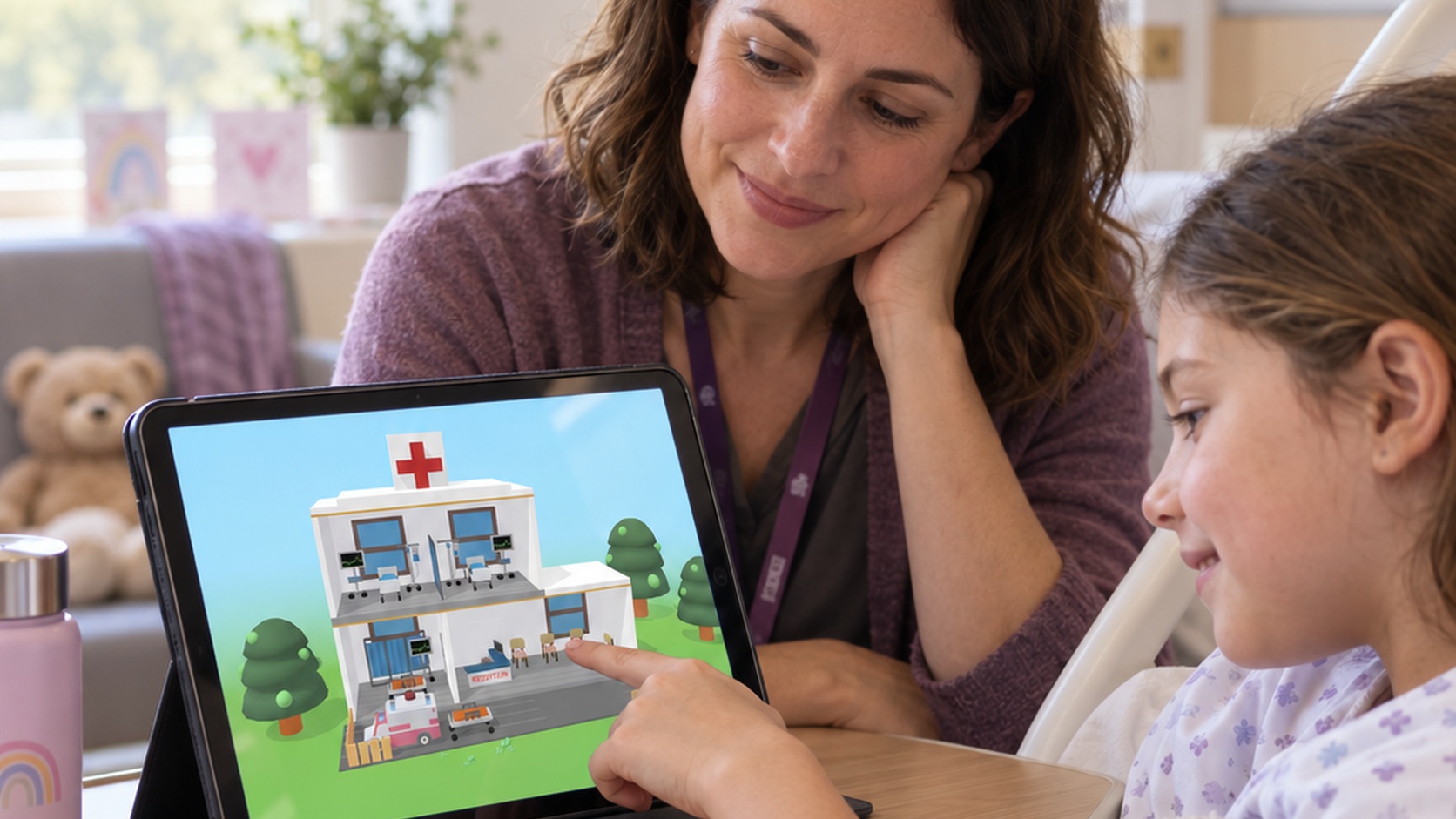
• Dollhouse: Invaluable for children processing the changed landscape of family after loss. Who lives in the house now? Where is the person who died? How does the family move through their days? Children reorganize and rehearse through the dollhouse what they are not yet able to say out loud.
• Whiteboard: Used for externalization. I might ask a teen to “draw what grief feels like right now”, no art skills required, no right or wrong answer. What they create becomes a shared object we can both look at, discuss, and return to. This transforms a subjective internal experience into something we can examine together.
• Therapeutic Worksheets: For neurodivergent clients specifically, I use the structured worksheets in PlaySpace to provide scaffolding around the symbolic work (e.g., a feelings map after a sandtray session, a memory-keeper activity between sessions, a visual representation of the “continuing bonds” they maintain with the person who died).
All of this is available virtually, which means that a bereaved nine-year-old in a rural community, or a sixteen-year-old who is school-refusing in the aftermath of a parent’s death, can all access the same quality of symbolic grief work. That matters enormously.
The Bird Doesn’t Know Where to Go, and That’s the Work
My client with the bird in the sandtray eventually placed the bird on the bridge. Then, in one session near the end of our work together, she moved it to the other side.
She didn’t explain it. She didn’t need to. We both understood.
That is what symbolic expression in grief therapy does. It gives clients a landscape to move through when their internal world has no map yet. It trusts the process. It trusts the symbol. It trusts the client’s own inner wisdom to find its way through loss, at their pace, in their language, with a therapist present enough to witness the journey without rushing the ending.
Whatever tools you use, whether it is physical or digital, sandtray or storybook, whiteboard or miniature, the heart of the work is the same.
Bear witness. Follow the symbol. Trust the process.
The rest will come.
Support Your Grieving Clients With the Right Tools
PlaySpace offers a complete suite of symbolic, expressive, and play-based tools designed by therapists for therapists, including the digital sandtray, AI storybook creator, therapeutic worksheets, and much more. Whether you work with grieving children, teens, or neurodivergent adults in person or virtually, PlaySpace meets your clients where they are.
Explore PlaySpace and try the sandtray with your next grieving client. You might be surprised by what they build.
.jpg)