Last week I was in Austin.
Not for the tacos (though, yes). For Inside the Lab, APA Labs’ annual conference on the future of mental health care, held October 14–15.
Here’s what made it different from most conferences I attend: the room wasn’t just clinicians talking to clinicians. It was clinicians, payers, investors, regulators, researchers, and founders, all in the same sessions, all talking about the same pain points, and all trying to figure out how to fix them together.
That mix matters. The people who deliver care, the people who pay for it, the people who regulate it, and the people who build the tools rarely sit at one table. When they do, you learn where the real friction is and where the real agreement is.
I left with two takeaways I think every play therapist should hear. One confirmed something many of you already feel in your bones. The other surprised me, in the best way.
Who was in the room
A quick snapshot, because the audience shapes the message:
- Clinicians across psychology, counselling, social work, and psychiatry, from solo private practice to large telehealth groups
- Payers and health systems thinking about reimbursement, access, and outcomes
- Investors and founders building the next generation of digital mental health tools
- Regulators and standards bodies working on what “safe” and “effective” should mean for digital care
- Researchers connecting the dots between evidence and practice
I spoke on two panels, one on scale versus personalization and one on youth mental health in the digital age. But the most useful hours were the ones spent listening.
Takeaway 1: The room agreed. Youth mental health is the most pressing issue.
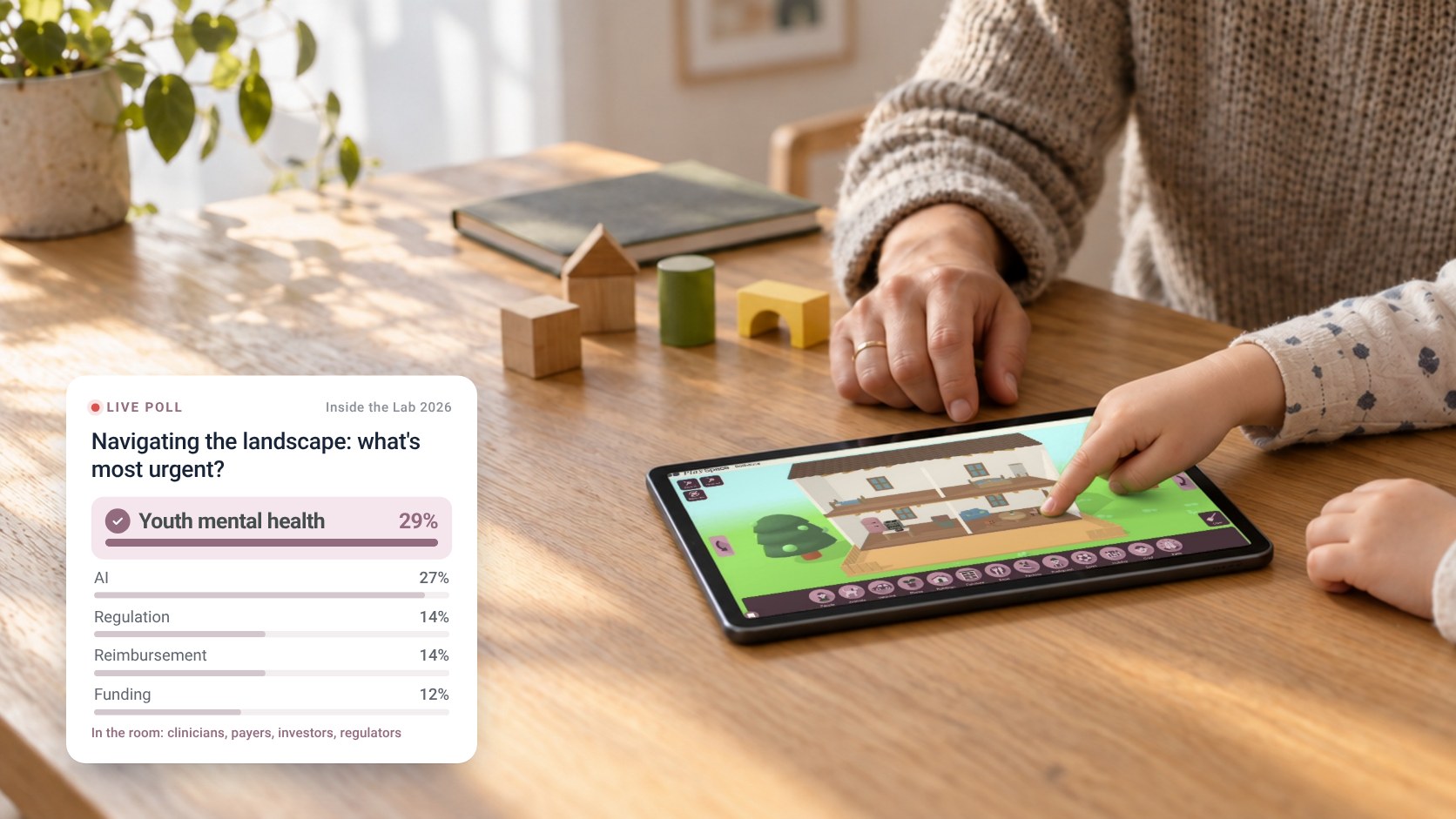
At one point, attendees were polled on the most pressing issue in mental health care today.
The answer, across clinicians, payers, investors, and regulators alike: youth mental health.
I’ll be honest. I needed to hear that.
Over the past few months I’ve had more conversations than I can count where someone, usually well-meaning, couldn’t see the “value proposition” of focusing on young people. Kids are complicated. Parents and caregivers are in the mix. Consent, confidentiality, and billing all get harder. Why not start with adults and work backwards?
So to sit in a room full of people with very different incentives and watch them land on the same answer was reaffirming. It told me two things.
First, the play therapists I know are doing some of the most important work in the field. You are working with the population that everyone in that room, from the person signing the cheques to the person writing the regulations, recognizes needs the most attention. That is not a niche. That is the front line.
Second, PlaySpace is focused on the right thing. We need more solutions designed for young people that meet them where they are. You cannot take a tool that was designed, tested, and validated for adults, shrink the font, add a cartoon, and call it a kids’ product. Children and teens are developmentally distinct. They deserve tools and resources built for their unique needs and stage of life.
The room also understood the stakes. Addressing the youth mental health crisis isn’t just prudent. If we don’t, the social and economic consequences land on all of us, for decades.
Takeaway 2: Clinicians want in on technology. They just don’t know where the door is.
This one was awesome to see.
The story we’re often told about clinicians and technology is one of resistance. That’s not what I saw in Austin. Clinicians were curious, engaged, and asking sharp questions. They want to know how technology can help their clients. And they want their voices heard in how it gets built.
What they don’t have is a map.
The questions I heard, over and over:
- “Where do I even start?”
- “Which tools can I trust?”
- “How do I figure out what to recommend to a family?”
- “How do I get involved? Is there a part for me to play?”
That last one stuck with me. The interest wasn’t limited to “what should I use.” It was “how can I shape this.” Clinicians want a seat at the table where the tools are designed, tested, and refined.
And I get why it feels out of reach. You’re overworked. Margins are slim. Some days you want to step back from all of it, not add one more thing. That’s fair.
But here’s the part nobody says out loud: just as you don’t know where to start, those of us building the tools often don’t know when or how to ask. We assume you’re too busy. You assume we’re not interested. Everyone stays polite and nothing happens.
So I’m going to be direct.
If you want to be involved, tell me
PlaySpace loves clinician involvement. It’s how we were built, and it’s how we get better. If you have ideas, questions, a frustration you wish someone would fix, or a research interest, I want to hear from you.
That could look like:
- Giving feedback on a feature before it ships
- Joining a clinician advisory conversation about what young clients actually need
- Participating in research on engagement, therapeutic alliance, or outcomes with children and teens
- Sharing a case story (de-identified) about what works in your sessions
- Simply telling us what you wish existed
You don’t need a research background. You don’t need to be “tech-savvy.” You need to know kids, and you already do.
A few ways to start evaluating tools with confidence
Until the field gives you a better map, here’s the one I use:
- Ask who built it. Were clinicians involved in design, not just marketing? Were children and teens involved in testing?
- Ask about evidence. Is the tool grounded in established therapeutic methods, and is the company measuring outcomes?
- Ask about safety and privacy. Look for independent security attestations and clear answers on how client data is handled. (PlaySpace, for example, is SOC 2 Type II compliant.)
- Ask about independent review. Programs like the APA Labs Digital Badge (which PlaySpace passed in the spring) exist so you don’t have to vet everything alone.
- Trust your clinical judgment. If a tool doesn’t make engagement easier in a real session with a real kid, it isn’t the right tool, whatever the pitch says.
The bottom line
Two days. One very mixed room. Two clear signals.
The field agrees that young people are the priority. And the clinicians who serve them want to help shape the tools, not just use them.
If you’re a play therapist, that puts you in a powerful position. The work you do is the work the field says matters most. The perspective you hold is the one builders need. The gap between you and the people designing the future of care is smaller than it looks, and it closes the moment one of us reaches out.
Consider this me reaching out.
Want a part to play in pediatric behavioural health?
If you have ideas, want to give feedback, or are curious about research, email me directly at drcawley@playspace.health. No pitch required. Tell me what you’re seeing in your sessions and what you wish existed.
Not ready for that yet? Two smaller steps:
- Subscribe to the PlaySpace newsletter (the sign-up is at the bottom of this page) for conference takeaways, clinical tips, and early looks at what we’re building with clinicians.
- Book a free, personalized demo and see what a platform built for young people, with therapists, feels like in a real session.